
Turkey Tail
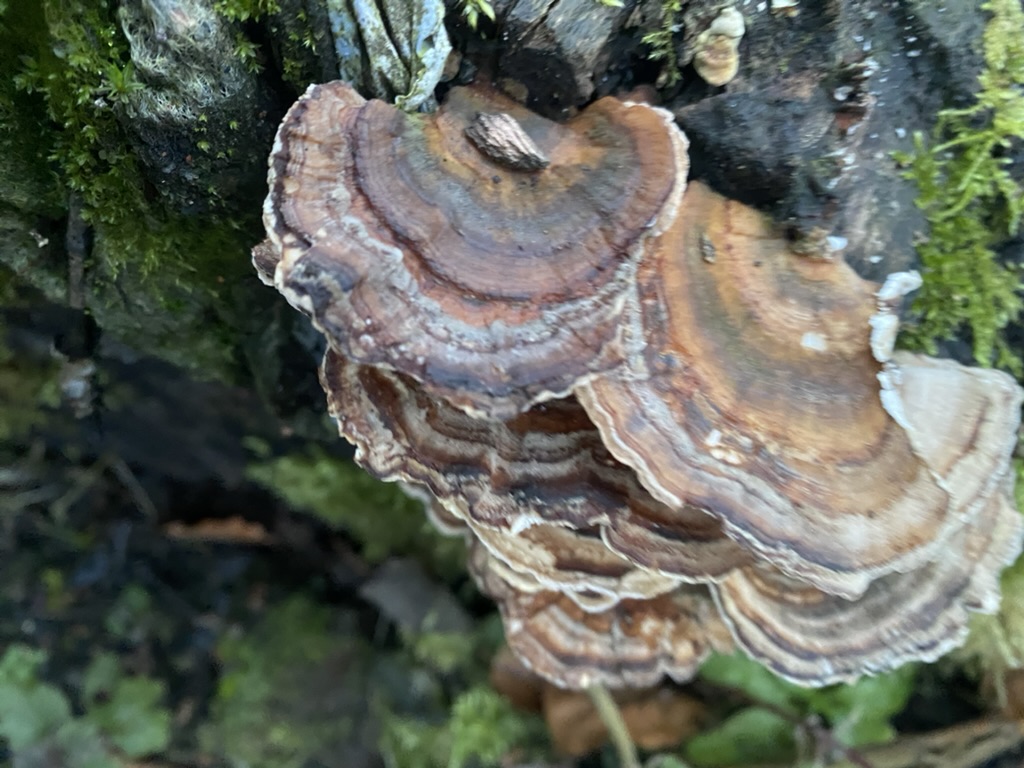
Turkey Tail (Trametes versicolor) is a common bracket fungus that grows on dead wood, easily recognised by its colourful, fan-shaped layers resembling the feathers of a turkey’s tail. It has a long history of use in traditional medicine, particularly in Asia, where it’s valued for supporting the immune system. Modern research has focused on compounds like polysaccharopeptide (PSP) and polysaccharide-K (PSK), which are believed to have immune-modulating and antioxidant properties, though evidence is still developing.
Turkey Tail Tea
To make a simple tea, dried Turkey Tail pieces are simmered gently for about an hour (roughly 2–3 grams per cup of water), strained, and can be enjoyed warm or stored in the fridge for later use. The resulting decoction has a mild, earthy flavour and is sometimes blended with other herbs to improve taste.
Look-alikes
Turkey Tail (Trametes versicolor) has several look-alikes, some harmless and others best avoided, so careful identification is important before harvesting. Here are the main species it’s often confused with:
False Turkey Tail (Stereum ostrea or Stereum hirsutum) – The most common look-alike. It can appear in similar colourful bands but lacks visible pores on the underside; instead, the underside is smooth or slightly hairy. True Turkey Tail always has tiny white pores underneath.
Violet Toothed Polypore (Trichaptum biforme) – Also fan-shaped and colourful, but with a violet or lilac edge and a toothed, not pored, underside. It often fades to grey with age.
Hairy Bracket (Trametes hirsuta) – Usually thicker, paler, and more uniform in colour, often white or grey rather than banded. The top surface is densely hairy and lacks the striking multicoloured zones.
Coriolus species variants – There are other Trametes species that resemble T. versicolor but tend to have less distinct banding or grow on different wood types.
Lenzites betulina (Birch Mazegill) – From above it looks similar, but the underside has gill-like folds rather than pores.
The key features of true Turkey Tail are: thin, flexible brackets; concentric coloured zones (brown, tan, blue, or green with age); and a white underside densely covered in minute pores.
Note: Always confirm identification with an experienced mycologist or local foraging guide before using any wild fungi for food or medicine.
Drying
Drying Turkey Tail (Trametes versicolor) is simple and helps preserve its medicinal compounds for tea or tinctures. Here’s how to do it properly:
Harvest carefully – Choose fresh, firm brackets from clean hardwood logs (avoid those growing on conifers or wood with mould). Brush off debris and insects, and trim away any tough or dirty base tissue.
Clean gently – Wipe with a damp cloth if needed, but avoid soaking, as they absorb water easily and take longer to dry.
Slice if thick – Most Turkey Tail fruiting bodies are thin, but larger or older ones can be cut into smaller strips to dry more evenly.
Air drying – Spread the pieces in a single layer on a mesh rack or paper towel in a warm, well-ventilated place out of direct sunlight. This can take several days.
Dehydrator or oven – If you prefer faster drying, use a dehydrator set to about 40–45 °C (105–115 °F) or a fan oven on its lowest setting with the door slightly open. Dry until they’re crisp and snap easily.
Storage – Once completely dry, store in an airtight jar or paper bag in a cool, dark place. Properly dried Turkey Tail can last for a year or more.
You can later grind them to make tea more efficiently, or use whole pieces for decoctions.
Note: I am not medically or dietetically qualified, and this information is for general interest only. Anyone considering using plants or wild fungi for health purposes should seek professional advice from a qualified practitioner.