
Broadleaf Plantain
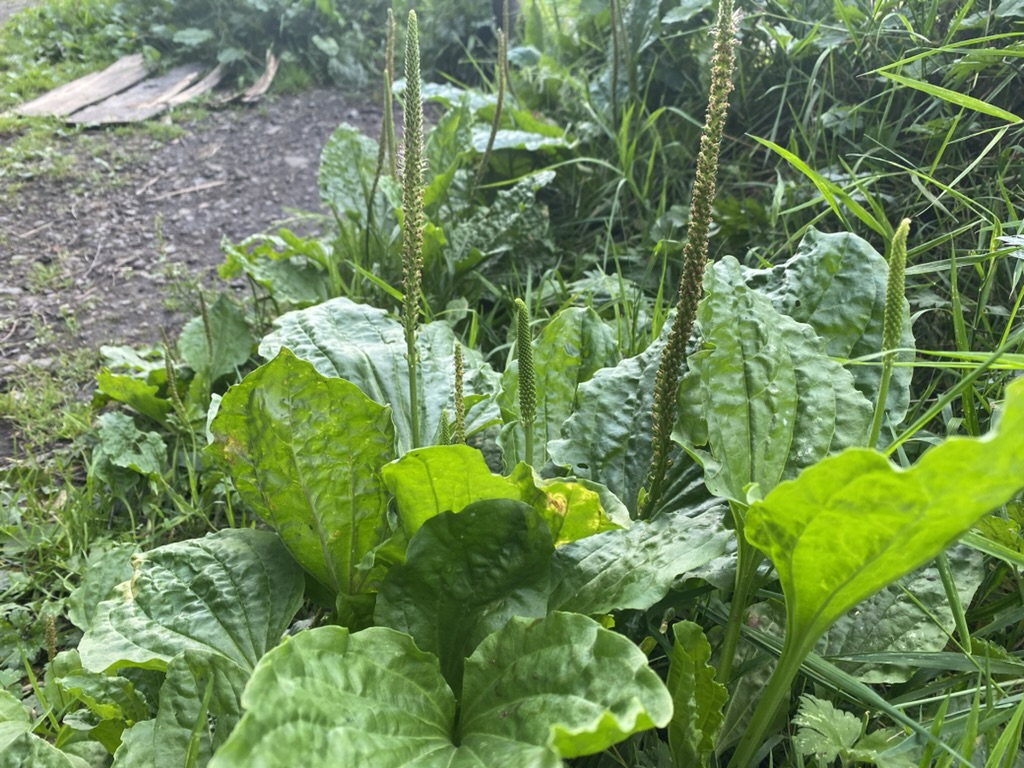
Broadleaf Plantain, (Plantago major) called Common Plantain or Greater Plantain, is one of the most widespread and resilient wild plants in Britain. You’ll find it thriving along paths, lawns, field edges, and even compacted ground in Worsley Woods — a plant most people step on daily without noticing. Despite its humble appearance, it’s one of the most useful wild herbs, valued for both food and traditional medicine for centuries.
Culinary Uses
- The young leaves are edible raw or cooked. Early spring leaves are tender and slightly earthy, ideal for adding to salads or soups.
- As the plant matures, the leaves toughen and are better steamed, sautéed, or added to broths much like spinach.
- Older leaves can be dried and powdered as a nutrient-rich thickener, high in fibre and minerals.
- The seeds (smaller relatives of psyllium husk) can also be harvested and used to add mild bulk to breads, smoothies, or porridge — though collecting them is a patient task.
Identification
Broadleaf Plantain forms a low rosette of oval leaves with pronounced parallel veins that run from base to tip. The leaves are smooth-edged, sometimes slightly toothed, and can grow up to 15 cm long. From the centre of the rosette rise tall, slender flower spikes covered in tiny greenish-white blooms that later turn into brown seed heads.
When crushed, the fresh leaves have a mild, grassy scent. The stems contain fine threads that stretch when pulled — a good identification clue.
You’ll usually see it in open grassy patches, sunny paths, and woodland edges throughout spring and summer. It’s easily distinguished from Ribwort Plantain (Plantago lanceolata), which has narrower, lance-shaped leaves.
Forager’s Notes
- Harvest only from clean, chemical-free areas — avoid roadsides and dog-walking paths.
- Pick healthy, clean leaves away from roadsides, dog-walking areas, or sprayed verges.
- Choose young to mid-mature leaves — older ones can be tougher and slower to dry.
- Harvest on a dry day, ideally late morning once dew has lifted.
- The plant is perennial, so cut leaves sparingly and allow it to regrow.
- It is safe to touch and handle but, as always, confirm identification carefully before using.
- Plantain’s root system also helps repair compacted soil, making it a sign of healthy ground renewal.
Traditional Medicinal Reputation
Broadleaf Plantain has an ancient reputation as a “first-aid” plant. Herbalists have long used its leaves as a natural remedy for minor wounds, insect bites, and stings. When crushed or chewed, the fresh leaf releases a soothing sap rich in allantoin, aucubin, and tannins, compounds associated with anti-inflammatory and healing properties.
It has also been used traditionally as a mild expectorant and digestive herb, and infusions of the leaf have been taken to ease sore throats, coughs, or mild gastrointestinal irritation.
Modern herbal research continues to explore these traditional claims, and while evidence is still limited, Plantago remains a favourite in folk medicine across Europe, often nicknamed “the bandaid plant”.
How to Use
Poultice – Crush a clean, fresh leaf and apply directly to an insect bite, nettle sting, or small cut.
Infusion / Tea – Steep 1–2 tsp of dried leaf in hot water for 10 minutes. The tea has a mild, earthy flavour and can be blended with mint or chamomile.
Syrup / Tincture – Some herbalists prepare plantain syrup for soothing coughs, but this requires accurate identification and hygienic processing.
Drying Broadleaf Plantain
Preparation
Rinse briefly if dirty and dry thoroughly with a towel — moisture encourages mould.
Remove damaged sections or stems if desired (stems can be dried too).
Air-Drying (best for preserving properties)
Lay leaves in a single layer on a mesh rack, paper towel, or muslin cloth.
Keep in a warm, airy place, out of direct sunlight.
Turn occasionally for even drying.
Drying time: 3–7 days, depending on humidity.
Leaves are ready when they are crispy and crumble easily.
Dehydrator Method (quickest)
Set dehydrator to 35–45 °C (95–113 °F).
Lay leaves in a single layer.
Dry for 2–6 hours, checking periodically.
Oven Drying (if no dehydrator)
Set oven to its lowest setting.
Prop door slightly open for airflow.
Dry for 1–3 hours, checking every 20–30 minutes.
Avoid high heat — it can damage beneficial compounds.
Storage
Store fully dried leaves in airtight jars or paper bags.
Keep in a cool, dark cupboard.
Shelf life: up to 1 year if kept dry.
Label with date and plant name — especially useful when drying multiple herbs.
Caution & Disclaimer
Broadleaf Plantain is considered safe for most people when used as food in moderate amounts, but wild plants can vary in strength. Anyone pregnant, breastfeeding, or taking prescription medication should consult a qualified herbal or medical professional before regular medicinal use.
Note: I am not medically or dietetically qualified, and this information is for general interest only. Anyone considering using plants or wild fungi for health purposes should seek professional advice from a qualified practitioner.